 English
 العربية


Written by: Hemocure Medical Team | Medical Review: Dr. Mohamed Magdy El-Najgar
The most critical question for any hemorrhoid patient is not "What disease do I have?" but rather "What should I do now?".
Amid a massive influx of conflicting information online, inherited traditional recipes, and advertisements promising miraculous solutions, patients often feel lost and unsure where to begin.
This guide from the Hemocure medical team is a genuine effort to provide a clear, scientifically grounded roadmap of the hemorrhoid treatment options available today, offering complete transparency regarding the pros and cons of each method. The treatment decision is ultimately yours, and our role is to empower you with accurate information to choose with confidence.
Before We Begin: Do Hemorrhoids Always Require Treatment?
The answer might surprise you: not every occurrence of hemorrhoids requires immediate medical intervention. Many first-degree cases respond excellently to simple lifestyle modifications. But when does ignoring the symptoms become a major mistake?
Signs Demanding Immediate Medical Treatment:
-
Recurrent rectal bleeding, even if minor.
-
Persistent pain that disrupts your daily life.
-
A palpable lump that is increasing in size.
-
Prolapsed hemorrhoids after bowel movements.
-
Formation of painful blood clots (thrombosis).
-
Symptoms affecting your sleep quality or work performance.
-
Persistent symptoms for more than a week despite home care.
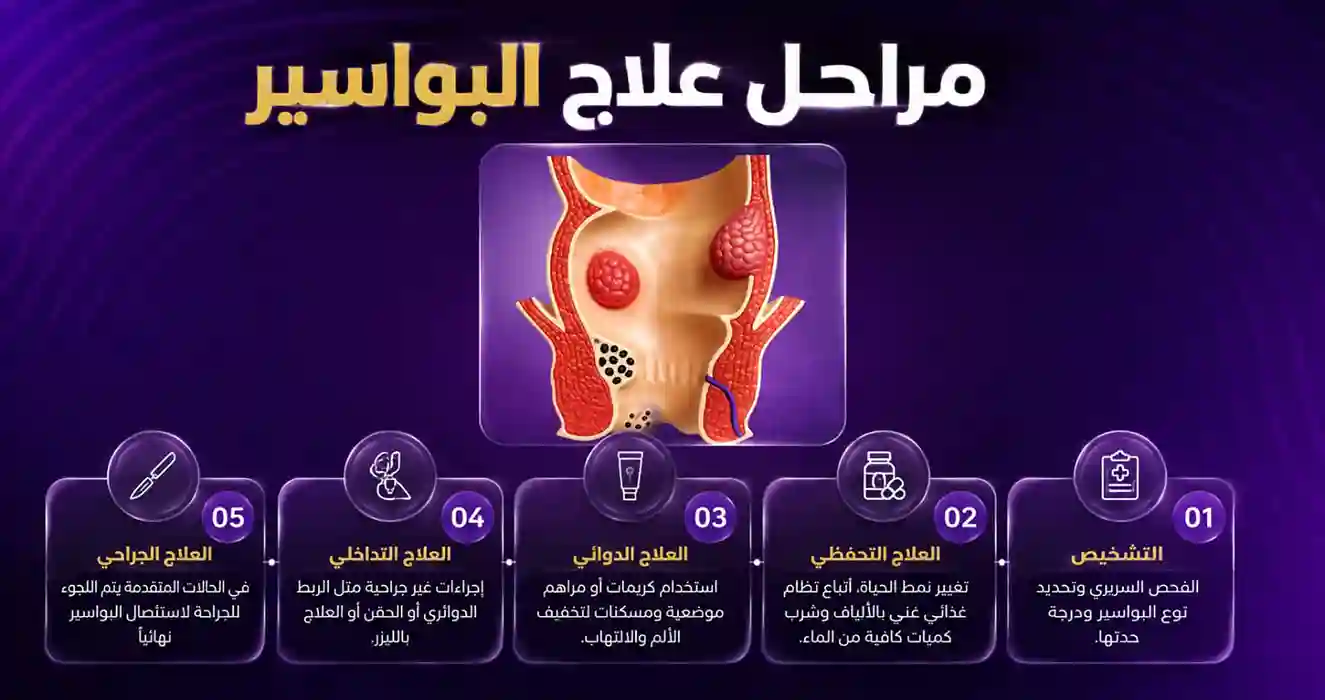
Stage 1: Home Treatment and Lifestyle Modifications
Before jumping to any medical procedure, we must start with the basics. Many mild hemorrhoid cases (first-degree) improve completely just by adjusting a few daily habits.
1. Increasing Dietary Fiber
Fiber is a hemorrhoid patient's best friend. It keeps the stool soft and easy to pass, thereby reducing pressure on the anal blood vessels.
-
Where to find fiber?
-
Leafy Greens: Spinach, lettuce, watercress, parsley.
-
Fruits: Apples, pears, oranges, berries, kiwi.
-
Legumes: Fava beans, lentils, beans, chickpeas.
-
Whole Grains: Oats, barley, brown rice, whole-wheat bread.
-
Nuts and Seeds: Almonds, flaxseeds, chia seeds.
-
Recommended Intake: 25-35 grams of fiber per day for adults.
2. Drinking Adequate Amounts of Water
Fiber without water can actually make the problem worse instead of solving it. Therefore, you must drink at least 8-10 cups of water daily, while minimizing dehydrating beverages like coffee and alcohol.
3. Avoiding Straining During Bowel Movements
Chronic straining is a primary cause of hemorrhoid development. Practical tips include:
-
Go to the restroom as soon as you feel the urge; do not delay.
-
Do not sit on the toilet for extended periods (no more than 5 minutes).
-
Elevate your feet slightly using a small stool to ease evacuation.
-
Breathe normally and do not hold your breath.
4. Warm Sitz Baths
Sitting in warm water for 10-15 minutes, 2-3 times a day, significantly relieves pain and swelling, especially after a bowel movement. Epsom salt can be added for greater benefit.
5. Regular Physical Activity
A daily 30-minute walk or swimming improves blood circulation and reduces pressure on the pelvic veins. Avoid strenuous exercises that increase intra-abdominal pressure (such as heavy weightlifting).
6. Avoiding Prolonged Sitting
If your job requires sitting for long hours, make sure to stand up every 30-45 minutes, even if just for two minutes. Use a specialized medical seat cushion designed for hemorrhoids to relieve pressure.
Stage 2: Medical and Pharmacological Treatment
When home treatment alone fails, the doctor resorts to a group of medications that may be sufficient to control the condition, especially in the early stages.
-
Topical Medications (Creams and Suppositories): These contain anti-inflammatory agents, local anesthetics, or corticosteroids to quickly alleviate symptoms, helping reduce itching, pain, and swelling.
-
Oral Medications for Vascular Support: These contain natural flavonoids like "Diosmin" and "Hesperidin", which strengthen blood vessel walls and reduce swelling.
-
Mild Laxatives: These help soften stool and prevent constipation, reducing strain on the anal vessels (used for short periods only).
-
Pain Relievers: Paracetamol is the safest choice. It is advised to avoid ibuprofen and aspirin as they may increase bleeding.
Stage 3: Laser Hemorrhoid Treatment — The Pinnacle of Medical Evolution
This is where true excellence begins. Laser technology for hemorrhoid treatment completely transformed the landscape since it was first introduced in Egypt in 2014 by Dr. Mohamed Magdy El-Najgar, in cooperation with the German company Biolitec.
Read also: hemocureclinic.com/aalag-alboasyr-ballyzr-am-algrah-altklydy
LHP Technology (Laser Hemorrhoidoplasty)
This is the gold-standard tech approved globally for hemorrhoid treatment. Using the Leonardo Plus 1940nm device, the physician inserts a very thin optical fiber into the hemorrhoid, emitting precise laser energy that achieves three effects:
-
Closing Blood Vessels: The laser seals off the arteries feeding the hemorrhoid.
-
Tissue Shrinkage: The hemorrhoid shrinks and diminishes gradually.
-
Stimulating Fibrosis: The remaining tissue fuses with the anal canal wall, preventing recurrence.
Why is LHP the Ultimate Choice?
-
No large surgical incisions; only a microscopic opening to insert the optical fiber.
-
No stitches or wounds requiring suturing.
-
Minimal post-operative pain, easily managed with standard pain relievers.
-
The patient is discharged from the hospital on the exact same day.
-
Return to normal life within 2-3 days, and back to work within a week maximum.
-
Success rate exceeding 95% without recurrence of the problem.
-
Full preservation of the anal sphincter function (no incontinence risk).
-
Suitable for all degrees of hemorrhoids, even the fourth degree.
THD Doppler Technology
A complementary technique to laser, utilizing an ultrasound device (Doppler) to precisely locate the arteries supplying the hemorrhoids, which are then ligated to cut off the blood supply. It is used on its own or combined with LHP depending on the case.
Multi-Technology Combination Protocols
In advanced cases (third and fourth degrees), we at Hemocure utilize a protocol that combines multiple techniques in a single session, ensuring incomparable results:
-
LHP to treat the hemorrhoid tissue itself.
-
THD Doppler to ligate the feeding arteries.
-
Additional cosmetic procedures for skin tags, if present.
Stage 4: Traditional Surgery (The Last Resort)
Conventional surgical hemorrhoidectomy was the only option for advanced cases for a very long time. However, it has become rarely used today because laser replaces it in 95% of cases.
When Do We Resort to Traditional Surgery at Hemocure?
-
Very rare cases presentation with severe complications.
-
Presence of concurrent conditions that require comprehensive open surgery.
-
Laser treatment failure (extremely rare).
Disadvantages of Traditional Surgery:
-
Severe post-operative pain lasting for weeks.
-
A hospital stay of 2-3 days.
-
A prolonged recovery period that can last up to a month.
-
Surgical stitches requiring meticulous medical care.
-
Higher risk of complications or sphincter muscle weakness.
How to Choose the Most Suitable Treatment for You?
The short answer: Do not choose on your own. Select a specialized doctor you trust and let them suggest the most appropriate plan. However, here are some general guidelines:
-
If you are at the 1st Degree: Begin with home remedies and medical treatment.
-
If you are at the 2nd Degree: Consider LHP laser as a definitive solution.
-
If you are at the 3rd or 4th Degree: Laser is undisputedly the ideal option.
-
If you have concurrent conditions: Fistula, fissure, or skin tags — Hemocure treats all of these concurrently in a single session.
Why Do Thousands of Patients Choose Hemocure for Hemorrhoid Treatment?
-
Pioneering Spirit: Dr. Mohamed Magdy El-Najgar was the first to introduce laser hemorrhoid treatment to Egypt in 2014.
-
International Authority: Chairman of the Training Council at the International Society of Colo-Proctology (ISOLP) since 2019.
-
Extensive Experience: Conducted more than 82 international workshops, with thousands of successful cases.
-
Exclusive Technologies: Leonardo Plus, LumenEye X1, SphinKeeper, VAAFT, FiLaC, and SiLaC.
-
Integrated Healthcare Network: 30+ branches, alongside a specialized hospital (Al-Rahma Hospital in Katameya).
-
Official Recognition: Awarded the State Incentive Award in 2018 in recognition of his contributions to medicine.
-
Safe Anesthesia: Advanced "Saddle Block" technique ensuring complete patient comfort.
❓ Frequently Asked Questions About Hemorrhoid Treatment
Is laser hemorrhoid treatment painful?
The procedure itself is painless as it is performed under local "Saddle Block" anesthesia. After the operation, the pain is very mild and managed with ordinary painkillers, completely incomparable to the severe pain of traditional surgery.
How long does the laser procedure take?
It takes between 30 to 45 minutes on average, and the patient returns home on the same day.
When can I return to work?
Most patients return to their jobs within 3-7 days, depending on the nature of their work and individual healing rates.
Do hemorrhoids return after laser treatment?
The recurrence rate is exceptionally low (less than 5%). When it does occur, it is usually linked to the patient failing to adjust their lifestyle and diet post-treatment.
How much does laser hemorrhoid treatment cost at Hemocure?
The cost varies based on the degree of the hemorrhoids, the need for additional techniques, and the presence of concurrent conditions. We provide a medical evaluation before transparently detailing the treatment plan and its cost.
Does health insurance cover laser hemorrhoid treatment?
Many health insurance companies cover laser treatment. Hemocure is contracted with major insurance providers; you can contact us to check the details for your specific policy.
Add New Comment