 English
 العربية


Not every case of hemorrhoids is treated the same way, and not every case needs surgery. Some improve by changing diet and toilet habits alone, others respond to medication, and others need a simple laser procedure or surgery. It all starts with one question: what is your grade, and what is driving your symptoms?
This page explains it plainly: when you can be treated without surgery, what laser treatment does and does not solve, and when surgery is genuinely the right option. Last updated: 11 November 2026.
Hemorrhoid treatment: when do you need medical care?
Hemorrhoids are enlarged veins in the anal canal and lower rectum. Symptoms are aggravated by chronic constipation, straining on the toilet and long sitting. Grade 1 often needs nothing more than lifestyle changes, but some signs should never be managed at home without an examination:
- Recurrent anal bleeding, even if it is light or only after a bowel movement.
- Persistent pain that affects work and sleep, not just discomfort after the toilet.
- A palpable lump that keeps growing, or prolapse that has to be pushed back by hand.
- A thrombosed hemorrhoid with sharp pain in the first 48 hours.
- Symptoms lasting more than a week despite home care and dietary changes.
If recurrent bleeding comes with dizziness, breathlessness or unexplained fatigue, an examination is not optional — a blood count may be needed to check your haemoglobin. For the condition itself, see what are hemorrhoids: symptoms and causes, and for the home-care steps first, the full guide hemorrhoid treatment: from home remedies to laser.
The four grades of hemorrhoids — and the treatment for each
The clinical grading of internal hemorrhoids is based on whether the prolapse reduces on its own, needs manual reduction, or does not reduce at all. That grade is what sets the treatment plan:
- Grade 1: bleeding with no prolapse — dietary and lifestyle changes first, plus medication when needed.
- Grade 2: prolapse that reduces spontaneously — conservative treatment works well here, and in selected cases a simple office procedure is added.
- Grade 3: prolapse that needs manual reduction — a minimally invasive procedure becomes realistic, and laser is one of the options used.
- Grade 4: prolapse that does not reduce — the option is decided after examination, and surgery has to be discussed openly with the patient.
External hemorrhoids behave differently from internal ones: the swelling around the anal opening needs its own assessment even when the grade looks similar.
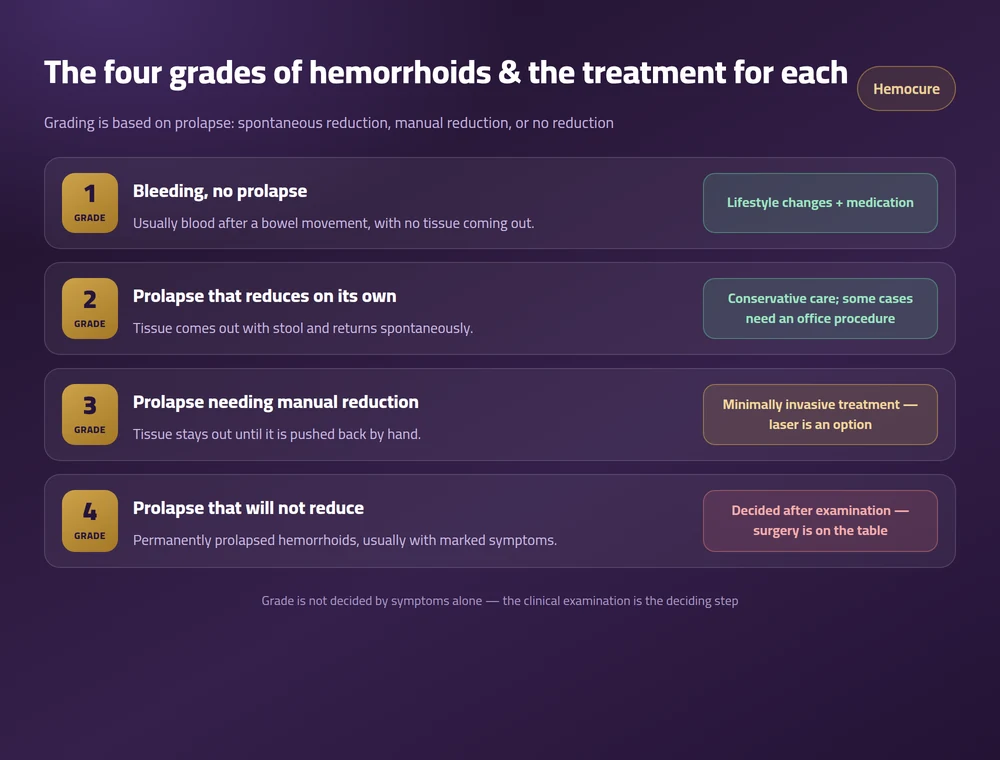
The four grades of hemorrhoids — each grade has a different plan
See it explained: the four grades of hemorrhoids
A short video from the Hemocure channel on YouTube walks through the grades and when medication is enough versus when an intervention is needed:
Treatment options at Hemocure clinics
1. Conservative and medical treatment. This covers diet (enough fibre and fluids), avoiding straining, warm sitz baths, and topical anti-inflammatory or venoactive medication that supports the vessel walls. It resolves many early-grade cases, but it controls the symptoms rather than removing the hemorrhoids — and buying creams without a diagnosis hides the real problem. Details in medicines used to treat hemorrhoids.
2. Laser treatment. An office-based procedure: the laser works on the enlarged tissue and helps close the congested vessels, without a large surgical incision. The expected advantages are less bleeding during and after the procedure, faster recovery and less visible scarring. Full details in complete guide to laser hemorrhoid surgery. One point has to be clear: laser is not suitable for every grade, and the decision comes after an examination — not from a web page.
3. Surgery. Still the option for advanced cases, for cases where other methods failed, and for specific situations such as a thrombosed hemorrhoid or a coexisting problem. An honest comparison of the two approaches is in laser versus conventional hemorrhoid surgery.
Laser or surgery — how is the decision made?
There is no single answer that fits everyone. What decides it:
- The type and grade of the hemorrhoids (internal / external / thrombosed).
- Severity and frequency of symptoms — recurrent bleeding changes the priority.
- Your general health and medication, especially blood thinners.
- How fast you need to return to work and the nature of your job.
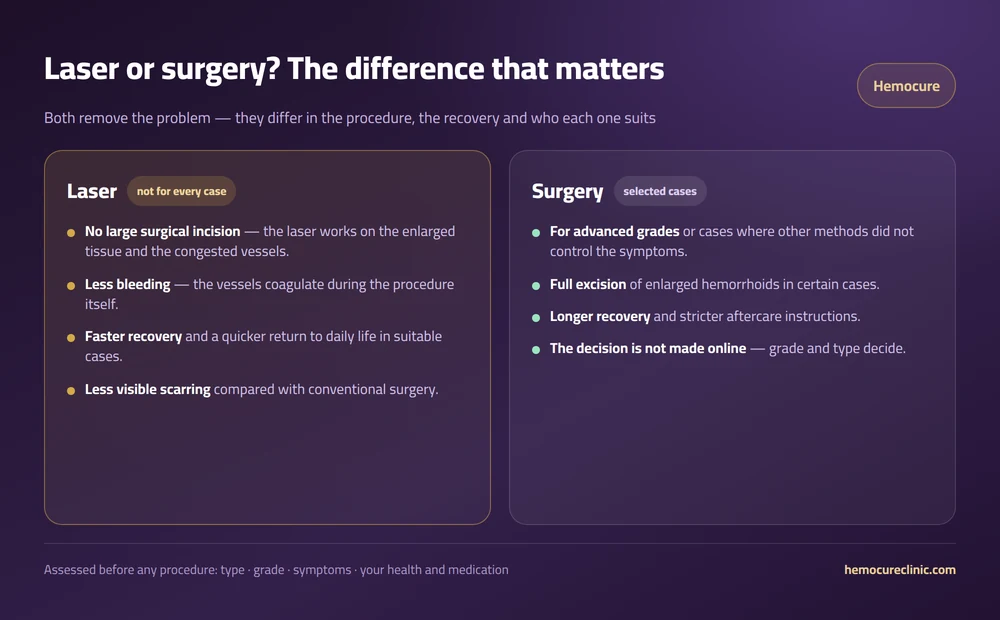
Laser or surgery? The difference is in the procedure and the recovery
That is why the examination matters: two patients can describe the same complaint and still need completely different plans. A remote consultation is useful for follow-up, but it cannot rule out other conditions that mimic hemorrhoid symptoms.
Your treatment day at Hemocure, step by step
- Examination and diagnosis: a clinical assessment of the symptoms and the grade.
- A written plan: conservative, medical, laser or surgical — with the advantages and disadvantages of each option spelled out.
- Preparation: the preparation instructions and any tests required before the chosen day.
- The procedure: as per the plan; the technique is decided case by case.
- Follow-up: aftercare instructions and a review appointment to assess healing and outcome.
Choosing a hemorrhoid doctor
What matters is a specialist in colorectal surgery who examines and follows up personally, and who gives you a clear plan rather than just a prescription. At Hemocure clinics these procedures are performed under the supervision of Dr. Mohamed Magdy El-Naggar; his background in hemorrhoid and laser treatment is on Dr. Mohamed Magdy El-Naggar's page. The medical decision in the end has to come from a doctor who has examined you — this page explains the options and their order, it is not a substitute for an examination.
Frequently asked questions about hemorrhoid treatment
Is laser hemorrhoid treatment painful?
The procedure is done under local anaesthesia, and most patients describe the period afterwards as mild discomfort or burning rather than the sharp pain of conventional surgery. Pain levels vary with the grade and the type of procedure.
Do hemorrhoids come back after laser treatment?
Laser removes the current problem, but if the causes remain (chronic constipation, straining, long sitting) they can return. That is why the aftercare instructions are part of the treatment, not an optional extra.
Is hemorrhoid surgery difficult?
These are among the smaller operations in colorectal surgery, they take a short time, and most patients go home the same day. The hard part is not the procedure itself but sticking to the aftercare.
Is bleeding from hemorrhoids dangerous?
Not every bleed is dangerous, but recurrent bleeding, increasing volume or a change in the colour of the blood must be examined — hemorrhoid symptoms overlap with other conditions that have to be ruled out.
Do hemorrhoids always need surgery?
No. A large proportion of cases are managed with conservative and medical treatment; laser and surgery are for persistent symptoms or advanced grades.
When should I see a hemorrhoid doctor immediately?
With recurrent bleeding, severe pain, a growing lump, or symptoms lasting more than a week — and without delay if you are anaemic or on blood thinners.
Book your appointment at Hemocure
If you want to settle the question of your hemorrhoids and choose the right plan for your case, book a consultation through the contact page, and find your nearest Hemocure branch. An early examination saves time and pain, and keeps more treatment options open.
Add New Comment